
A seventh-grader's math gap is often in grade four
Placing a child by their school year assumes the year taught them. When a seventh-grader is stuck, the skill that is actually missing is frequently several grades below. We built a placement check to find it, then took it out: its accuracy was only ever simulated. Here is what Radlic does instead.
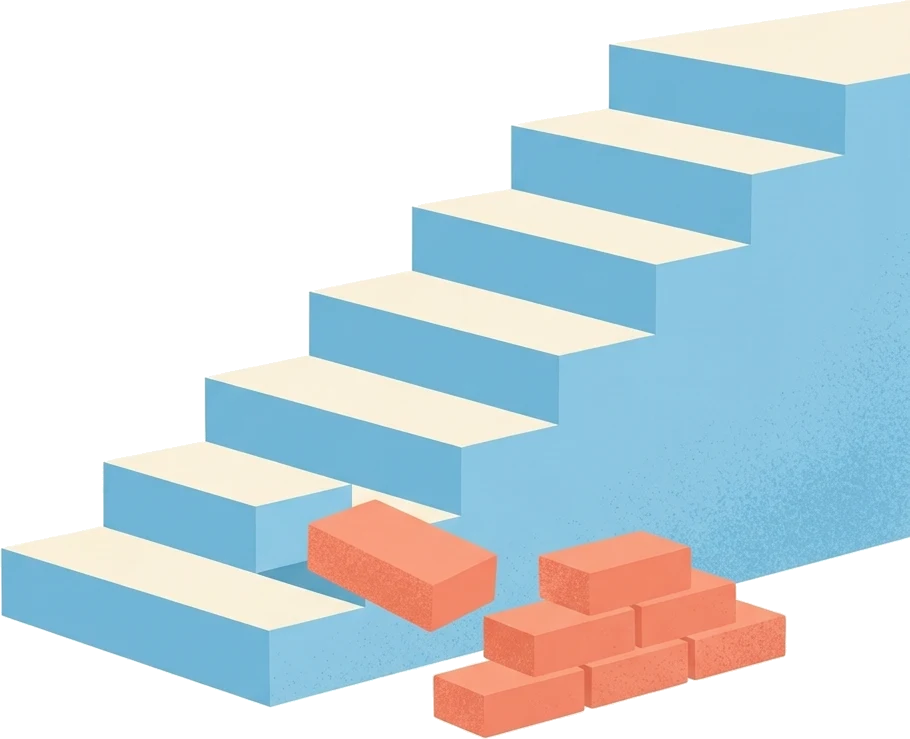
When a seventh-grader cannot solve the equation in front of them, the instinct is to teach the equation again, more slowly. Sometimes that works. Often it does not, because the equation is not where the problem is.
Placing a child by their school year assumes the year taught them. That assumption is doing an enormous amount of unexamined work, and when it is wrong it is wrong quietly — the child keeps being handed material one level above a gap nobody has looked for.
What a grade is actually evidence of
A grade level tells you what a child has been taught. It is a record of attendance and curriculum, not of understanding, and the two come apart constantly and without announcement.
This matters more the higher the grade, because the gaps compound. A missing idea in grade four does not stay in grade four. It sits underneath fractions, then underneath ratio, then underneath everything in algebra that depends on ratio, and each layer built on top makes it harder to see — what you observe in grade seven is a child failing at equations, not a nine-year-old who never quite got equivalence.
Teaching the equations again treats the symptom you can see.
What we tried, and why we took it out
When this post was first written, Radlic started with a short placement check. It walked a graph of skills and their prerequisites: when a skill expected for the child's age failed, it descended into that skill's prerequisites, and kept descending until it reached one whose own prerequisites all passed. That skill was the root gap, and it was meant to be the first thing taught.
We removed the check on 20 September 2026. The idea behind it still holds; our evidence that it worked did not. Its accuracy had only ever been measured in simulation, never against real children, and a check that names the wrong root sends weeks of teaching to the wrong place. A placement result we could not stand behind was worse than none, so we took it out rather than keep it with a caveat.
What Radlic does instead
It does not guess where the root is. It shows the adult where the trouble is, lets them reach back to any grade, and keeps weak skills in play.
A parent sees where the child is stuck. The parent's report shows how often the child's first try was right, and lists a topic as stuck once the child has done six or more practice problems in it and fewer than half were right on the first try. That is a narrower signal than a root gap — it shows where the trouble appears, not where it starts — but it comes from the child's own answers.
The parent can reach back to any grade. Lessons are chosen by the parent, as whole modules or single topics, from any grade. If the algebra trouble looks like fractions underneath, the parent can give the child the fractions topics, without the child being told they are going back.
Weak earlier topics come back. Practice mixes in a problem from the weakest earlier topic the child has finished but not mastered, so a skill that did not stick is revisited instead of being built on.
The difficulty keeps moving inside every topic. A child who starts too high drops to easier questions within a few answers, and one who starts too low climbs.
What we have not solved
The hard part — finding the root without a parent's judgement — is the part we took out. A parent can see that a child is stuck on ratio; the app does not yet tell them the trouble is in grade-four equivalence. We would rather say that plainly than ship a check whose answer we cannot vouch for.
What the child sees
None of this.
There is no level, no score, no "you are working at a grade four standard". The report is for the parent. The child gets to not know they were being measured.
The useful part of finding a gap is teaching from it. Telling a child the number is not part of the job.